
Understanding Django Monitoring: Metrics, Logs, System Design
Many Django applications run for a long time "just fine." Requests come in, data is processed, responses go out. As long as nothing is obviously broken, the system feels stable.
Blog topic
Python ist eine vielseitige, interpretierte Programmiersprache, die für ihre Lesbarkeit, Einfachheit und umfangreiche Standardbibliotheken bekannt ist und sich hervorragend für verschiedene Anwendungsbereiche wie Webentwicklung, Datenanalyse, maschinelles Lernen und wissenschaftliches Rechnen eignet.
Articles
Many Django applications run for a long time "just fine." Requests come in, data is processed, responses go out. As long as nothing is obviously broken, the system feels stable.

Django has long been a framework for quickly building functional applications. A few models, some views, a bit of template code, and a project was up and running. This way of thinking is now only partly valid.

Many Django projects start pragmatically. A few models, a few views, maybe a serializer – and everything works. The problem only becomes apparent later: The logic gets distributed uncontrollably throughout the code, making it increasingly difficult to understand where what actually happens.
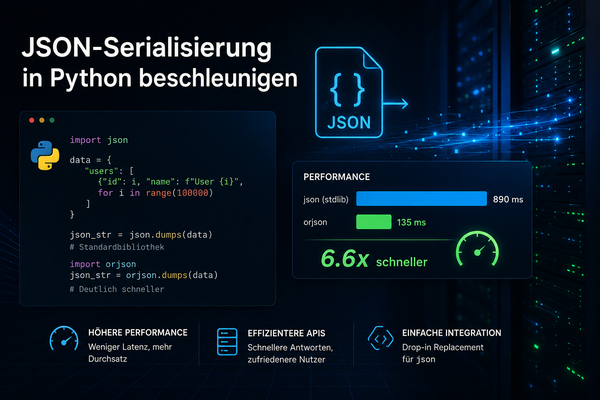
JSON serialization plays a crucial role in the performance of web applications, especially when transferring data in and out of APIs. Python’s built-in JSON library is convenient and powerful, but it can quickly reach its limits with larger datasets.

The speed at which APIs serialize and deserialize data is a crucial factor for the performance of a web application.

The examples and suggestions are based on best practices and demonstrate how to optimally use Django's tools.

Data science is a versatile field that combines statistics, machine learning, and data visualization. Python has established itself as one of the leading programming languages in this area because it offers a variety of powerful libraries for data processing, modeling, and visualization.

Performance issues in Django rarely arise from single errors, but rather from numerous small inefficiencies. This article shows how to systematically optimize caching, the ORM, and database access. The goal is an application that remains stable even under load.

When companies seek a stable and flexible platform for developing internal web applications, Django is often cited as one of the best candidates. This powerful web framework, written in Python, offers numerous advantages for building and operating intranet applications.

In Python, when exceptions occur, errors can be raised elsewhere in the code while preserving the original exception. This is particularly useful when you want to catch an exception but need to raise a new, more specific exception.

The shot put or projectile motion is a classic movement in physics involving two dimensions: horizontal and vertical. This motion can be described by combining uniform motion in the horizontal direction (no acceleration) with uniformly accelerated motion in the vertical direction (due to gravity).

In Numpy, axes play a central role in array manipulation. The concept of axes describes the dimensions along which operations like summing, averaging, or sorting are applied.

Sorting data is a fundamental task in numerical programming. Numpy offers various ways to sort arrays, including simple sorts, sorting along axes, and more complex tasks such as retrieving sorting indices.

In numerical programming, it is often necessary to create evenly spaced numerical values or intervals. Numpy provides several useful functions for this purpose, such as arange, linspace, and logspace.

In linear algebra, various types of matrices play a central role. These include the zero matrix, identity matrix, null matrix, diagonal matrix, and other matrices. Numpy provides a straightforward way to create and manipulate these matrices.

Transposing matrices is a fundamental operation in linear algebra. It swaps the rows and columns of a matrix. In Numpy, transposing matrices is particularly straightforward and can be done using the T attribute or the transpose() function.

NumPy offers powerful tools for array manipulation, and understanding how to merge arrays is essential for data analysis and scientific computations. Experiment with the provided examples to deepen your understanding!

When working with large datasets, Pandas is one of the most powerful and flexible tools in Python. It provides data structures and functions that make it easy to read and process data from various formats such as CSV or Excel files.