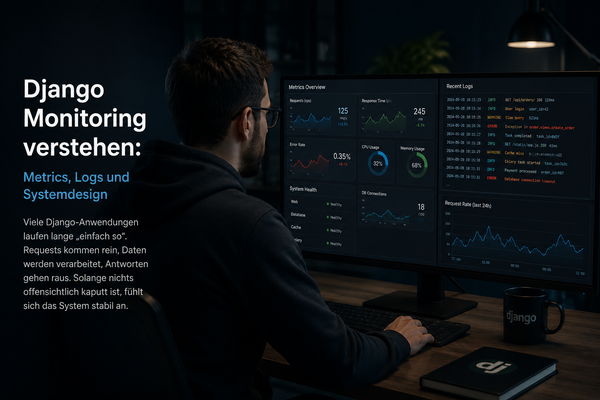
Understanding Django Monitoring: Metrics, Logs, System Design
Many Django applications run for a long time "just fine." Requests come in, data is processed, responses go out. As long as nothing is obviously broken, the system feels stable.
Articles
Many Django applications run for a long time "just fine." Requests come in, data is processed, responses go out. As long as nothing is obviously broken, the system feels stable.

Django has long been a framework for quickly building functional applications. A few models, some views, a bit of template code, and a project was up and running. This way of thinking is now only partly valid.

Starting Django projects often follows the same pattern. Create project, make apps, define models, build views, wire URLs. The problem isn’t complexity but repeating the same steps. Especially for new projects or prototypes, this wastes time and focus.

Many Django projects start pragmatically. A few models, a few views, maybe a serializer – and everything works. The problem only becomes apparent later: The logic gets distributed uncontrollably throughout the code, making it increasingly difficult to understand where what actually happens.

Maintainability does not arise by chance but through deliberate architectural decisions from the very beginning. This article demonstrates which layers, responsibilities, and project structures have proven effective in real Django projects—beyond tutorials and quickstarts.

Django significantly eases getting started – exactly this becomes a long-term curse for many projects. The article reveals typical structural mistakes that develop gradually and explains why a lack of architecture almost always leads to an explosion of technical debt.

The speed at which APIs serialize and deserialize data is a crucial factor for the performance of a web application.

The examples and suggestions are based on best practices and demonstrate how to optimally use Django's tools.

Performance issues in Django rarely arise from single errors, but rather from numerous small inefficiencies. This article shows how to systematically optimize caching, the ORM, and database access. The goal is an application that remains stable even under load.

When companies seek a stable and flexible platform for developing internal web applications, Django is often cited as one of the best candidates. This powerful web framework, written in Python, offers numerous advantages for building and operating intranet applications.