Mistral Vibe Explained: What It Is and How to Use It Effectively
In recent years, numerous AI tools have emerged promising to make software development faster and easier. Many of these, however, remain superficial and mainly assist with small code snippets or simple tasks.

Bernd Fischer
26. Mar 2026 · 5 min read
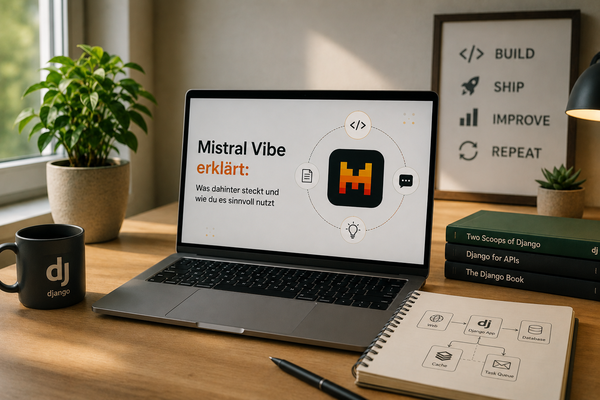
Mistral AI takes a different approach: powerful models designed explicitly for productive development workflows.
A concrete tool from this is Mistral Vibe, a CLI tool that works directly in your terminal to support you during development.
In this article, we will explore what Mistral AI actually is, how Vibe works, and where its real strengths and weaknesses lie.
What is Mistral AI?
Mistral AI is a European company specializing in the development of large language models (LLMs).
Their focus is strongly on performance, openness, and practical usability, especially in technical domains.
Unlike many closed systems, Mistral partially relies on:
- open or semi-open models
- high efficiency at lower costs
- strong performance on coding and reasoning tasks
For developers, this primarily means:
The models excel at understanding, generating, and transforming code.
What is Mistral Vibe?
Mistral Vibe is a command-line tool built on these models, designed specifically for developers.
It does not function as a classical chat interface but as an interactive assistant directly within the terminal.
The basic idea is simple:
You describe what you want to build → Vibe generates or modifies your code.
Typical use cases include:
- Generating project structures
- Creating boilerplate code
- Adding features
- Analyzing errors
- Writing documentation
An example:
vibe "Create a Python CLI tool that reads a CSV file and calculates summary statistics"
Vibe then produces a suitable structure including code you can run immediately.
How to Use Vibe Effectively?
The biggest mistake is to treat Vibe like a "better autocomplete function." Its strength lies not in single lines of code but in entire workflows.
1. Generate Projects Instead of Snippets
Instead of just creating functions, you should describe complete projects:
vibe "Create a Python data science project with preprocessing, feature engineering, model training and tests"
This results in:
- Structure
- Separation of concerns
- Executable code
This saves you the entire initial phase of a project.
2. Work Iteratively
Vibe works especially well when you proceed step by step:
vibe "Add caching to the data loading layer"
vibe "Add logging to the preprocessing step"
You develop your project in a dialogue-like manner. This often leads to more consistent code than copying and pasting from various sources.
3. Utilize Debugging
An often underestimated use case is debugging:
vibe "Why does my Django API return 500 on POST?"
Instead of just googling error messages, you get context-aware suggestions. This is particularly helpful for complex frameworks or data pipelines.
Advantages of Mistral Vibe
1. Massive Time Savings on Boilerplate
A large part of development time is spent on repetitive tasks. Vibe largely eliminates these, allowing you to focus faster on the core problems.
2. Consistent Project Structure
Especially in larger projects, structure is crucial. Vibe often creates a cleaner separation of components from the start than manual setups.
3. Fast Iteration
New features or changes can be implemented very quickly without having to implement every detail yourself. This greatly accelerates experimentation.
4. Support for Learning
Vibe provides not only code but often implicitly delivers best practices. This helps you understand and apply new technologies faster.
Disadvantages and Limitations
1. Risk of Blind Trust
The generated code often appears correct but is not always so. Adopting it unchecked can quickly introduce hidden bugs.
2. Lack of System Understanding
Relying too much on Vibe results in less learning about the actual architecture or functioning of tools. This becomes a disadvantage with complex problems.
3. Quality Depends Strongly on the Prompt
Unclear or vague requests lead to mediocre code. Good results require precise problem descriptions.
4. Not Ideal for Highly Specialized Logic
Vibe solves standard problems very well. It reaches its limits faster with very specific, domain-specific requirements.
When is Vibe Truly Worthwhile?
Vibe excels at:
- Project setup
- Data pipelines
- Web backends (e.g., Django, FastAPI)
- CLI tools
- Prototyping
It is less suited for:
- Highly optimized low-level algorithms
- Complex system architecture without clear specification
- Safety-critical logic without review
Conclusion
Mistral AI provides powerful models that particularly impress in developer contexts. With Vibe, you get a tool that integrates these capabilities directly into your workflow.
The biggest advantage is not writing code faster, but spending less time on unnecessary structural work. Properly used, Vibe can significantly boost your productivity but does not replace your technical understanding.
👉 If you want to see how to use Vibe concretely for Django projects, check out this article: How to use Vibe to build a Django app